Home
» Tips
»
Printable One-Page Marketing Strategy Template for Local Businesses
Printable One-Page Marketing Strategy Template for Local Businesses
A current-state check of official small-business and local-marketing guidance in September 2026 shows that the fundamentals have not been replaced by a new platform or tactic. The U.S. Small Business Administration still emphasizes target market, competitive advantage, sales planning, and marketing budget. Google Business Profile still helps storefront and service-area businesses manage how they appear on Search and Maps, while Google Ads still supports geographic and radius targeting. For neighborhood mail, USPS Every Door Direct Mail still lets businesses select local routes and filter by demographic characteristics.
That is useful news for a local business owner: you do not need a 30-page marketing document to make better weekly decisions. You need a short plan that forces you to answer the few questions that determine where your time and money should go. The one-page template below is designed for that purpose.
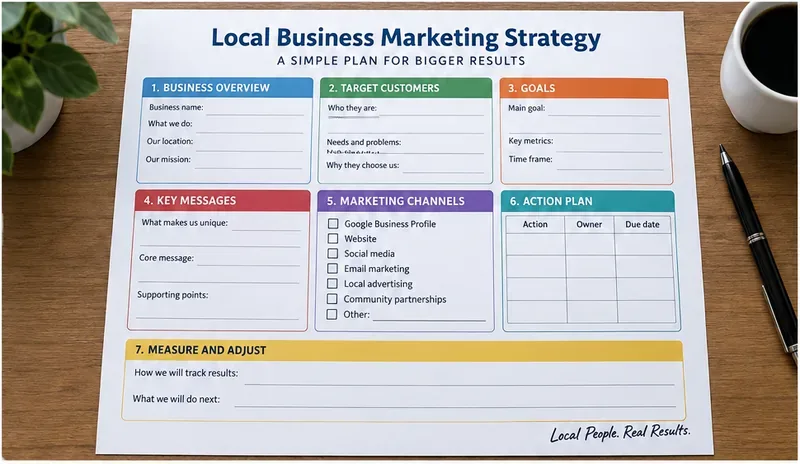
A printable local-business marketing worksheet keeps the audience, offer, channels, actions, and measurement plan visible on a single page.
Printable one-page marketing strategy template
Print this section, copy it into a document, or recreate it in your preferred office tool. Keep the answers short enough that the entire strategy remains visible at once.
Section
Write this on the one-page plan
1. 90-day objective
Primary business result: __________ Target number: __________ Deadline: __________
2. Ideal local customer
Who they are: __________ Where they live/work: __________ Problem or buying trigger: __________
3. Value proposition and offer
Why choose us: __________ Current offer or call to action: __________
4. Priority geography
Neighborhoods / ZIP codes / service radius: __________ Areas to exclude: __________
The template is intentionally restrictive. If a tactic cannot fit into the “top marketing channels” or “weekly actions” boxes, it probably should not be a current priority.
What this one-page plan is—and what it is not
A common misunderstanding is that a one-page strategy should contain every marketing idea the business might use. It should not. The goal is prioritization.
The SBA describes a marketing plan as a way to stay on schedule and on budget, and it lists sections such as target market, competitive advantage, sales plan, goals, action plan, and budget. Those ideas map naturally to a one-page operating version. See the SBA marketing and sales guide.
What is verified: target-market definition, competitive positioning, goals, actions, and budget are durable elements of a marketing plan.
What depends on your business: which channels deserve space on the page. A restaurant, dentist, home-service company, boutique, and B2B local supplier can all use the same planning structure but should not use the same channel mix.
Action: limit the plan to three primary channels for the next 90 days. You can keep a separate “later” list for everything else.
Start with one measurable 90-day objective
“Get more customers” is not specific enough to guide weekly choices. A usable objective combines a business result, a number, and a time period. Examples include “book 60 first-time appointments in 90 days,” “generate 120 qualified estimate requests this quarter,” or “increase weekday lunch transactions by 15% compared with the previous 90-day period.”
The exact metric depends on how customers buy. A service business may care about qualified leads and booked jobs. A store may care about transactions, store visits, repeat purchases, or average order value. A restaurant might care about reservations, orders, or redemption of a local offer.
Action: pick the business outcome first. Do not begin with a platform metric such as followers or impressions unless you can explain how it connects to revenue, leads, bookings, or visits.
Define the local customer by need and geography
The SBA's current market-research guidance recommends examining demand, market size, customer characteristics, location, market saturation, and pricing. For a local business, “location” is not a footnote; it often determines whether a lead can realistically become a customer. The SBA also recommends competitive analysis to understand strengths, weaknesses, market segments, and opportunities. See the SBA market research and competitive analysis guidance.
A useful local-customer description therefore has three parts:
Who: the customer type most likely to buy.
Why now: the need, trigger, or problem that creates demand.
Where: the neighborhoods, ZIP codes, towns, commute zones, or service radius where the business can profitably serve them.
For example, “homeowners within eight miles” is better than “everyone in the city,” but “homeowners within eight miles who need same-week HVAC repair” is more actionable still.
Action: write one primary audience in the template. If two audiences have different needs or buying journeys, treat them as separate campaigns rather than squeezing both into one vague sentence.
Write a value proposition that makes a local choice easier
A value proposition is not a slogan. It is the practical reason a customer should choose your business instead of another available option. For local businesses, useful differentiators can include speed, convenience, specialization, availability, trusted expertise, neighborhood familiarity, a guarantee, a distinctive product mix, or a specific service experience.
A simple formula is: For [customer], we provide [result] through [specific advantage].
Examples:
“For busy pet owners in North Park, we provide same-week grooming appointments with online booking and text reminders.”
“For homeowners in the west suburbs, we provide fixed-price plumbing repairs with evening appointment windows.”
“For nearby office teams, we provide pre-ordered lunch catering that is ready at a guaranteed pickup time.”
Action: replace adjectives such as “best,” “quality,” or “professional” with something a customer can understand, compare, or experience.
Choose channels based on the buying situation
There is no universally best channel for local businesses. The correct mix depends on how customers discover the category, how urgent the purchase is, whether the business has a physical location, and how wide the service area is.
Google Business Profile: useful when customers actively search nearby
Google states that an eligible, verified Business Profile can help storefront and service-area businesses manage how they appear on Google Search and Maps. Businesses can maintain hours, phone number, website, location or service-area information, photos, and reviews. See Google's Business Profile getting-started documentation.
Google also provides Business Profile performance metrics such as views, searches, calls, website clicks, and directions requests when those metrics apply to the profile. Not every metric appears for every business. See Google's Business Profile performance documentation.
Best fit: businesses that customers commonly discover through “near me,” category, map, or location-based searches.
Action: if Business Profile is a priority channel, place one interaction metric—calls, directions, website clicks, or bookings—on the one-page scoreboard instead of tracking only profile views.
Google Ads: useful when geography and purchase intent can be controlled
Google Ads supports targeting countries, regions, cities, and—in supported contexts—a radius around a location. Google notes that very small geographic targets can sometimes produce limited delivery. See the official location-targeting instructions.
Current Google documentation also says Local Ads can appear across Search, Maps, and Waze in eligible situations, using business information from location assets and linked Business Profiles. See Google's Local Ads documentation.
Best fit: categories with active search demand and enough margin to pay for customer acquisition.
Action: write the actual service geography in the template, including areas you should not pay to reach.
Email and SMS: useful when repeat business matters
Owned customer lists can be more valuable than continually paying to reacquire the same audience. The tradeoff is that list marketing depends on permission, accurate contact data, relevant offers, and a realistic communication cadence.
Best fit: businesses with recurring purchases, maintenance cycles, events, memberships, seasonal demand, or customers likely to return.
Action: define the purpose of each message stream—rebooking, offer, reminder, education, event, or loyalty—rather than “send a newsletter” as a generic task.
Community partnerships and events: useful when trust is local
Partnerships with nearby businesses, schools, associations, property managers, sports clubs, nonprofits, or events can be effective when customers make decisions through community trust. The downside is that partnership impact can be harder to attribute than a digital click.
Action: give every partnership a trackable mechanism such as a dedicated landing page, referral code, booking source, offer code, or simple “How did you hear about us?” field.
Direct mail: useful when neighborhood coverage matters
USPS Every Door Direct Mail allows businesses to select carrier routes and use filters including age, household size, and income. As of September 2026, USPS lists EDDM Retail postage at $0.26 per piece and states that EDDM Retail generally supports 200 to 5,000 pieces per day per ZIP Code. Pricing and rules can change, so verify them before budgeting. See the official USPS EDDM page.
Best fit: businesses with a defined neighborhood catchment area and an offer that works visually on a postcard, menu, flyer, or coupon.
Action: budget the full campaign—printing, creative, postage, and offer cost—not postage alone.
Turn channels into weekly actions
A strategy fails when it names platforms but not behaviors. “Instagram,” “Google,” and “email” are channels, not actions.
Better weekly actions sound like this:
Update one Business Profile photo and answer all new reviews by Friday.
Publish one neighborhood-specific service page this month.
Send one rebooking email to customers due for service.
Review paid-search terms and location performance every Monday.
Contact two potential community partners each week.
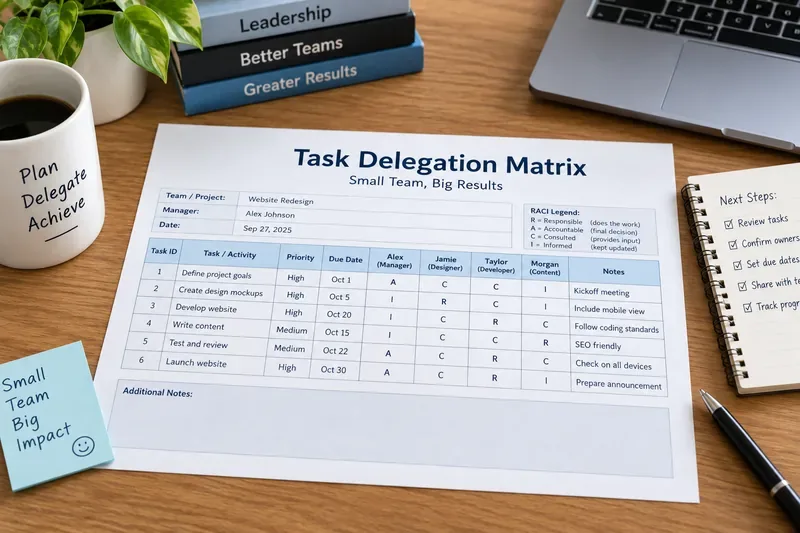
The one-page format forces each activity to have an owner and due date. That is especially important in small teams where “marketing” can otherwise become everybody's responsibility and nobody's scheduled work.
Action: if an action cannot be completed or reviewed within the next week or month, break it into a smaller task.
Set a budget before the channels compete for it
Marketing budgets do not need to follow a universal percentage rule. Margin, repeat purchase rate, capacity, seasonality, and customer lifetime value vary too much for one percentage to fit every local business.
The SBA recommends including costs in the marketing plan and comparing marketing expenses with the revenue they generate. That approach is more useful than adopting a generic benchmark without context. See the SBA marketing plan guidance.
A practical one-page budget can have only three lines: paid media, local/offline activity, and tools/creative. The important part is to decide the total before adding channels.
Action: reserve a small test budget rather than committing the entire amount to an unproven campaign. Define in advance what result would justify increasing spend.
Use a scoreboard that answers “is this working?”
The template asks for a primary and secondary metric, not a dashboard full of numbers. The primary metric should match the 90-day objective. The secondary metric can diagnose the path toward that result.
Business goal
Primary metric
Useful secondary metric
More booked service jobs
Booked jobs
Qualified leads or calls
More store traffic
Tracked visits or transactions
Directions requests, offer redemptions
Grow repeat revenue
Repeat purchases
Rebooking rate or email conversions
Grow local catering
Catering orders
Quote requests or landing-page conversions
Common misconception: more data always makes the plan more scientific. In reality, a crowded scorecard can make it harder to see whether the business objective improved.
Action: choose one result metric and one diagnostic metric, then review them on the date written on the template.
How often should you revise the page?
A 90-day cycle is a practical planning horizon for many local businesses because it is long enough to run campaigns and short enough to adjust. That is a planning recommendation, not a platform rule. Highly seasonal businesses may need monthly or event-based cycles; businesses with long sales cycles may need longer evaluation windows.
Do not rewrite the plan every time a post underperforms or a week is slow. Change it when the evidence suggests the audience, offer, geography, channel, budget, or execution cadence is wrong.
Action: schedule the review date when you create the plan. At the review, mark each channel “keep,” “change,” or “stop,” then produce the next one-page version.
A filled example for a neighborhood home-service business
90-day objective
Book 90 new residential repair jobs by December 31.
Ideal local customer
Homeowners within a 12-mile service radius who need same-week repairs.
Value proposition
Fixed-price repair quotes with evening appointment windows.
Priority geography
Three highest-converting ZIP codes; exclude areas beyond profitable travel time.
Top channels
Google Business Profile, paid search, customer reactivation email.
Weekly actions
Respond to reviews; review search/location performance; email customers due for maintenance.
Budget
$2,000 paid media; $300 creative/tools; $200 test reserve.
Scoreboard
Primary: booked jobs. Secondary: qualified calls/forms. Review every Monday.
This example is illustrative, not a claim that those channels or budget levels will work for every home-service business. The value of the template is that it makes those assumptions explicit so you can test them.
Final check before you print
Is the 90-day goal measurable?
Can a team member describe the ideal customer in one sentence?
Does the offer give a concrete reason to act?
Is the service geography explicit?
Are there no more than three priority channels?
Does every weekly action have an owner?
Is the monthly budget capped?
Can you tell from two metrics whether the plan is working?
Is a review date already scheduled?
A one-page marketing strategy is not a substitute for detailed financial planning, campaign setup, creative briefs, or legal/compliance review. Its job is narrower and more useful day to day: keep the local business focused on the customer, the offer, the geography, the few channels worth executing, and the evidence that will determine what to do next.